Quick Summary
Specialized weapon stores focus on firearms, ammunition, optics and tactical gear, so their staff typically have deep firearms knowledge and they often carry niche items like Class 3 NFA products. They also usually build their process around FFL transfers. Big-box retailers offer broader general merchandise, but their staff knowledge and specialty stock vary.
- Specialized stores focus inventory on firearms, ammunition, optics and tactical gear.
- Staff at specialized stores are typically firearms-focused, offering hands-on product guidance.
- Class 3 NFA items are often a core category at specialized stores but rarely stocked by big-box retailers.
- Transfer handling at specialized stores is usually built around FFL transfers.
- Ask each store about its transfer process, return policy and post-purchase support before buying.
Table of Contents
- Why Buyers Compare Specialized Weapon Stores With Big-Box Retailers
- Product Expertise and Hands-On Guidance From Specialized Stores
- Buying Firearms Online vs in Store: Where Each Option Fits
- How the Online Purchase and FFL Transfer Process Works
- Inventory, Specialized Items and Customization Services
- Liability, Insurance and Legal Compliance Considerations
- The Local Gun Store Advantage: Support, Community and Long-Term Service
- Choosing the Right Store for Your Next Firearm Purchase
- Frequently Asked Questions
Why Buyers Compare Specialized Weapon Stores With Big-Box Retailers
Last Updated: November 14, 2026
Shoppers looking for firearms usually face the same choice: specialized weapon stores or a large retailer. FAFO TACTICAL is a specialized gun shop and weapon store. Specialized stores focus on firearms, ammunition, optics and tactical gear, while big-box retailers sell firearms alongside many unrelated products.
The difference shows up in how each type of store handles the purchase. Specialized stores focus their inventory on firearms, ammunition, optics and tactical gear, including Class 3 NFA items.
Here is how the two options typically compare:
| Factor | Specialized Weapon Store | Big-Box Retailer |
|---|---|---|
| Product focus | Firearms, ammunition, optics, tactical gear | Broad range of general merchandise |
| Staff knowledge | Typically firearms-focused | Varies by department and location |
| Specialty and Class 3 items | Often a core category | Rarely stocked |
| Transfer handling | Usually built around FFL transfers | Depends on the store’s process |
Neither option is right for every buyer. A specialized store makes the most sense when you know what you want and need depth in that category.
Product Expertise and Hands-On Guidance From Specialized Stores
The main advantage of a specialized store is the depth of product knowledge behind the counter.
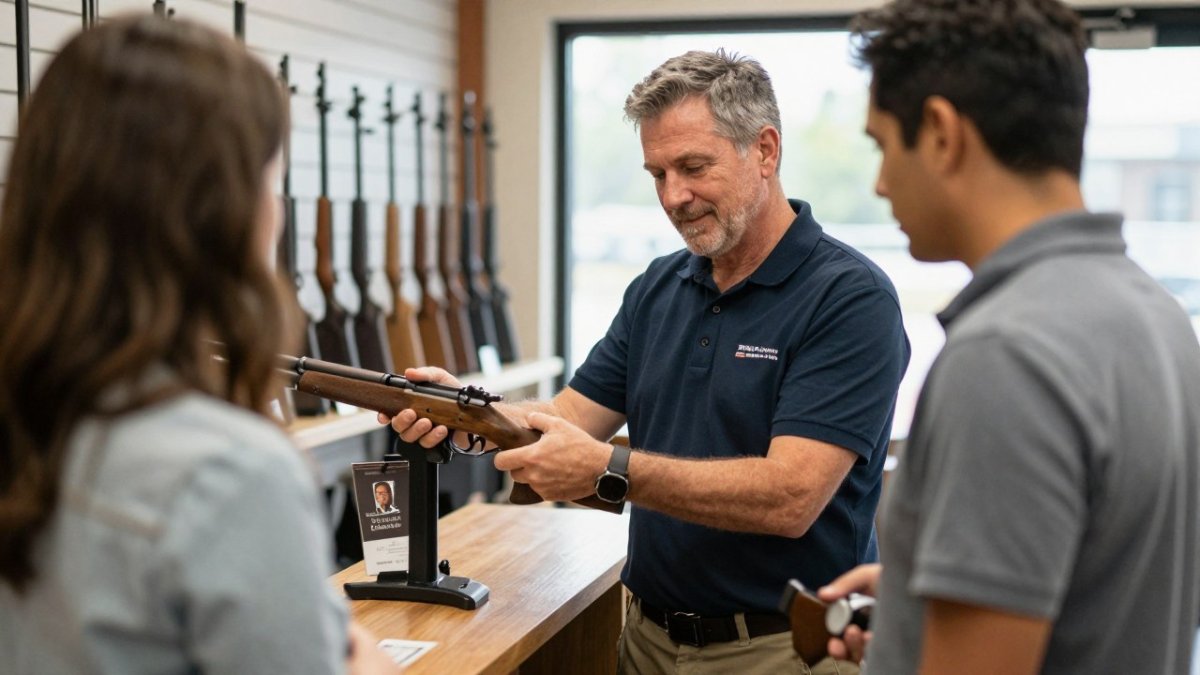
!A knowledgeable store employee showing a customer a rifle on a counter in a well-lit gun shop
When you are choosing a red dot sight, for example, the details matter. A compact optic like the SIG SAUER ROMEO X Reflex suits a range of pistol and rifle setups, and a knowledgeable employee can explain how the reticle and footprint affect your choice. For hearing protection, the SureFire Comply Foam Tips Full Block Earplugs are a practical addition to any range visit.
If you want to go further before buying, our buyer’s guide to optics for long-range sport shooting covers the main trade-offs. A specialized store can also help you select accessories that fit the optic and firearm you already own.
Buying Firearms Online vs in Store: Where Each Option Fits
Online buying and in-store buying each suit different situations. Online shopping gives you wider selection and easier price comparison.
Buying firearms online always involves a licensed dealer step. The firearm ships to a Federal Firearms Licensee (FFL) rather than directly to you, and that FFL completes the transfer.
How the Online Purchase and FFL Transfer Process Works
The online firearm purchase process has a few standard steps, but the details are where most buyers get stuck. Understanding them ahead of time prevents delays and surprise fees.
- Choose your firearm and place your order online. Confirm the seller is a licensed dealer and that the listing matches the model, caliber and configuration you intend to buy.
- The firearm ships to a Federal Firearms Licensee (FFL) near you, not to your home. You will typically enter the receiving dealer’s information at checkout, and many sellers keep a searchable FFL directory.
- You visit the FFL in person, present valid government-issued photo identification, and complete ATF Form 4473. The form records the transferee’s identity and the firearm’s details, and the dealer retains it.
- The dealer initiates the background check through the FBI’s National Instant Criminal Background Check System (NICS). Under federal law, a licensed dealer may not transfer a firearm until the check is completed or the statutory waiting period expires without a denial.
- You pick up the firearm once the transfer is approved. If NICS returns a denial, the dealer cannot complete the transfer, and the firearm typically returns to the seller under the seller’s policy.
Transfer fees are set by each receiving FFL, not by the online seller, and vary by dealer. Some dealers charge per firearm rather than per transaction, which matters if you are transferring multiple items. Ask about the fee, accepted payment methods and storage policy before you order.
Watch out: ordering a firearm to an FFL that has not agreed to receive it can delay your transfer by weeks or force a return. Call the dealer first, confirm they accept transfers from that seller, and get the fee in writing before you check out.
State rules layer on top of the federal process. Some states require a permit to purchase, a waiting period, or a state-level background check in addition to NICS, and some regulate specific firearms or magazine capacities. Check the rules where you live and where the dealer is located before ordering, since a compliant sale in one state may not be compliant in another.
Inventory, Specialized Items and Customization Services
Specialized stores often carry items that general retailers do not. Our inventory includes firearms, ammunition, tactical gear and Class 3 NFA items, which are regulated under the National Firearms Act. Class 3 purchases involve additional federal approval steps, so expect a longer timeline than a standard transfer.
Liability, Insurance and Legal Compliance Considerations
Owning a firearm carries legal responsibilities that start before the purchase. Storage, transport and use are governed by federal, state and local laws, and the rules vary enough that a setup that is compliant in one jurisdiction may not be in another. Before buying, review the rules where you live, including any requirements for safe storage, permits to purchase or carry, and transport between your home and a range.
Liability is an important consideration for firearm owners. Owners can face civil and criminal exposure if a firearm is misused, and the legal theories vary, negligence, improper storage, and in some states statutes that hold owners responsible for injuries involving their firearms. Many owners review their homeowner’s or renter’s insurance with an agent to understand what is and is not covered, and some add an umbrella policy. Insurance terms vary widely by carrier and state, so confirm coverage directly with your insurer rather than assuming a standard policy extends to firearms.
A licensed dealer plays a compliance role in every transfer. The dealer verifies identity, completes ATF Form 4473, runs the NICS check, and keeps records as required under federal law. That paperwork trail is one reason buying through an FFL is more defensible than a private transfer: the transaction is documented, and the dealer has already screened the buyer.
Keep your own records of every purchase and transfer. Receipts, FFL paperwork, serial numbers and dates protect you if questions come up later, and they simplify insurance claims if a firearm is lost or stolen. Store them separately from the firearms themselves.
Watch out: a private transfer that skips the FFL step can expose both parties to legal risk and, in many states, is itself a violation. If you are unsure whether a transfer requires a dealer, treat it as though it does and confirm with the dealer or a qualified attorney.
The Local Gun Store Advantage: Support, Community and Long-Term Service
Supporting a local specialized business also keeps firearms knowledge and community events close to home. Ranges, training classes and shooting groups often connect through local shops, which makes it easier for new owners to get started safely.
Choosing the Right Store for Your Next Firearm Purchase
Start with what you need. If you are shopping for a common firearm and want the lowest price, a large retailer or online store may be enough. If you want expert guidance, specialty items, or help with transfers and fitting, a specialized store is usually the better fit.
Ask each store about its transfer process, return policy and support after purchase. Compare the answers, not just the prices. At FAFO TACTICAL, our online platform includes integrated FFL transfer scheduling, so you can plan your purchase and transfer in one place. Browse our current selection and start your next firearm purchase with a clear plan for the transfer.
Frequently Asked Questions
Is it better to buy firearms online or in store?
Buying online gives you wider selection and easy price comparison, but every firearm bought online must ship to a licensed FFL dealer for the transfer, which adds fees and a waiting period. Buying in store lets you handle the product and ask questions in person. Many buyers do both, researching online and then picking up or transferring through a local dealer. Pricing depends on the item, quantity and shipping, so check current prices directly with the seller or FAFO TACTICAL for an accurate quote.
Can a specialized firearms store help arrange an FFL transfer?
Yes. A specialized store can receive a firearm shipped from an online seller and complete the transfer for you after a background check under federal law. The process generally requires you to fill out ATF Form 4473 at the receiving dealer and may involve a transfer fee set by the dealer. Requirements also vary by state, so confirm your local rules before ordering. FAFO TACTICAL offers integrated FFL transfer scheduling, and you can contact the company for current transfer details.
Do specialized gun stores offer better product advice than big-box retailers?
Specialized stores typically employ staff who focus on firearms, optics and accessories, so they can explain differences between models, calibers and configurations in more depth. Big-box retailers often rely on general sales staff who may handle many product categories. Specialized staff can also help with fit, intended use and maintenance basics. The quality of advice still varies by store, so ask specific questions about the product you are considering before you buy.
What should I check before buying a firearm from an online retailer?
Confirm the seller is a licensed dealer, verify that the firearm is in stock before paying, and review the return and cancellation policy. Check that the seller will ship to a licensed FFL dealer near you and ask about transfer fees and turnaround times. Make sure you understand your state’s laws on the firearm you are buying, including any NFA requirements for regulated items. Keep records of your order and communications in case a problem comes up.


